And so onto my time at Yee-Haw Industries.
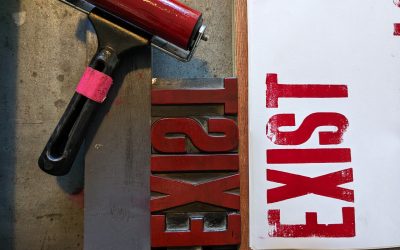
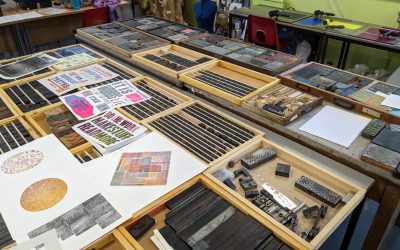
I first became aware of Yee-Haw Industries whilst working as a framer at the lovely little gallery, Castor and Pollux in Brighton. They had been stocking Yee-Haw’s work for a long time and I was intrigued by their work. Julie Belcher and Kevin Bradely are the brains behind the type, unfortunately during my time there Kevin was out of State and Julie was in and out getting ready for another art show where they had a stall. Yee-haw are an important touchstone in the now growing gig poster scene but they are part of the old guard and have been producing work since 1997, as such their studio is packed full of all their amazing prints (and a fair few CDs).


The large format print on the ceiling is of particular note. Although available in a variety of hand-set sizes, these huge “storety” pieces are designed and printed by Kevin on a modified etching press. With a print bed about the size of a single mattress this allows for some truly staggering prints.

The majority of Yee-haws work, and in fact I would guess most letterpress printers work, is done on a Vandercook Press . Whilst these presses in a traditional print environment were once used simply for proofing work before sending it to a more high speed press, they have since found favour with the letterpress craft movement due to their robust build, relative ease of maintenance and the speed at which you can print and register something. I have fallen in love with these presses, with paper grippers to register your paper and a set of rollers that ink your type automatically (though you still replenish the ink every 10 or so prints) printing in a joy, a speedy joy at that. Let me put it this way – on one day this week in a period of about 3 hours I printed a batch of Yee-Haw prints, roughly 600 of them. In 3 hours on the Albion Press I used to print my last edition on in 3 hours I would maybe get 30 good prints due to hand inking and hand puling each print. The Vandercook is still hand-printing, it’s just incredibly fast.

So alongside helping Yee-Haw keep ahead of orders for their lovely prints (check out their etsy shop ) I have also been able to work on a new print for myself. I have been trying to put into action all the things I have learnt over the past month and I’m really pleased with it, I’ll be putting the second colour on it today. I have also been making a short making of video so you can see a Vandercook in action but that will have to wait until Monday.
Knoxville Tennesseess….Tenessesse….Tenessesse…TN – Yee-Haw Industries
So before you can say “y’all come back” my week at Yee-Haw is almost over and I have been so busy I haven’t had a chance to make any posts this week. I have however been filling my week with fun things, for the sake of brevity I have split this weeks posts into two – one on Knoxville and one on Yee-haw.
I arrived via Greyhound (my second so far) on Saturday evening from Nashville, and was feeling a little worse for wear. The Greyhounds here can be a bit hit and miss – every time I’m at the station I see a fleet of the brand new buses with wifi and big comfy seats, these always then pull away to reveal my crappy one – sans wifi and sans big comfy seats, but normally with a full contingency of crazies/normal decent folk driven crazy by the conditions Greyhoud make you put up with. Greyhound have a frustrating tendency to, as far as I can tell, over sell tickets and then just try and deal with it if anything bad happens so it’s common to load your bag in the hold, queue up, get on board and then find there are no seats. Thankfully this hasn’t happened to me yet, if it does their front desk will feel the full scorn on a polite englishman who has been wronged. On my bus from Memphis to Nashville the week before I did sit opposite a big, fat man who kept pulling his t-shirt up, rubbing his belly and then shouting “WEEEEEYOOUU!”. I’m sorry America but some people are really letting the side down. Anyway, back to Knoxville. Greyhounds Stations have a tendency to also be in odd bits of the town, far away from things of interest. Arriving at around 7pm I had a hour to kill until I could get into my hostel (the owner was at a football game). Given the option of turning left or right out of the station I chose left due to seeing some signage I wanted to photograph (don’t judge me – you’re the one reading a blog about a letterpress research trip) and as luck would have it that led me into the area of town called “Old City”.

I hate to use this term but Knoxville has a really good “vibe”, arty and liberal without being too hip and disingenuous. In the Old City I found a nice coffee shop (where I’m in fact writing this now) and dug in there for a hour. In a rather fortunate stroke of serendipity my friend Owen Richards was also arriving in town tonight with a group of friends who are road tripping east to west across the states. So at the allotted time I arrived at the hostel, met with Owen and the others and headed into town. Calzones were eaten, root beers were drank and wander round town was had.
Sunday morning and the others left to get to their next destination whilst I departed for town and the promise of a morning latte. After getting a brief…actually not all that brief introduction from the hostels owner (turns out he used to be a tour guide) I was reminded of the Sunsphere in the town centre and it’s roll in a particular episode of the Simpsons . No wig store sadly but an abundance of sun and grass to idle on.

On the way back to the hostel I passed by Yee-haw and ogled their goods through the window and made a mental list of ways I could abuse my bank account in the store.

So it’s been a bit of a slow week with regards to posts on my blog, the reason being I have conversely very busy at Hatch knuckling down and helping out. In my last post I mentioned the sheer scale of Hatch’s level of production, between 500-600 designs are handset and printed each year. My experience at Hatch has been the application of my letterpress knowledge to a high speed and high volume print environment. Their mantra is that the “Printer is the designer”, jobs are either faxed or placed in person at the shop and simply consist of the copy needed and perhaps a very rough suggestion of what they want on it (“maybe something with a bird” etc). These are then divided between their team of interns and full time printers, Hatch’s house style is so synonymous with letterpress that having something for your brand/band/family both designed and printed is part of the appeal.
Seeing the everyday workarounds to the problems you encounter when printing remind me of my own experiences when I was regularly screen printing in my studio, you change your tools and space to suit your needs and not the other way round. The layout and work flow of the studio at first is incredibly jarring. For a start though there is a rough organisation to the type cases with regards to size and style there are as many anomalies to this organisation as there are standard placements. Though the drawers are roughly labelled the staff know the layout and it’s peculiarities so well that most of the type setting is done by memory. When printing a run of posters they are are first stacked vertically in small batches on a chair before being leant in these batches against the huge walls of shelves used to store the very large wood type. I will admit at first I was sceptical of this as a drying methods, but the proof was in the process–the chair is the perfect size to enable you to place a print in the current stack with no effort and whilst doing a large run it allows you to really get into the flow of things rather than having to break the motion by moving from the press to a drying rack.
So amongst this many armed, extremely productive beast of lead, iron and wood I have been rummaging through cabinets and helping to set type ready for restrikes (reprints) of original prints from their huge back catalog of designs.

For a person that doesn’t really care for country music (there I said it, please don’t judge me), Nashville seems like a pretty weird place. My first impression was a little like the first time I went to Camden High Street, except that rather than 15 year old kids shopping for New Rock boots and studded collars it’s filled with people in their 40’s buying cowboy hats and those funny little shoe lace tie things. Jim from the Hamilton Type Museum told me that there is live music being played out of every other shop front on the downtown strip, he wasn’t exaggerating (in fact I’d actually say it was an underestimate). As you wait to cross the street even the traffic lights play country music out of tiny street level speakers.
So the question is, what am I doing in Nashville? Well Nashville is home to Hatch Show Print, America’s best know print shop. I think I’m in Heaven.(Speaking of Heaven, in order to get to Nashville I took a 16hr over night trip via train and bus, 11hrs of which were spent sat next to a crazy man mumbling loudly about prophets and Judgement Day. That was definitely Hell.)


Hatch still functions as a fully working print shop, producing around 500-600 posters year, and when you find out that in general their minimum run of posters is 100 that’s a whole lot printing. I’ll be here for a week working alongside their printers and interns learning more about letterpress printing in a production environment.
There is a great video about Hatch here
And yes, they have cats, they are awesome. This one is called Huey, he has the build of a circus strong man

The Hamilton Type Museum
Type identification for letterpress can be a headache to say the least. When the trade was is it’s heyday the print shop was a bustling hive of organised chaos. Type was housed in labelled drawers, organised by it’s classification and it’s size. The furniture and leading for the type was also kept in strictly organised areas related to size (both by heigh and by width, for a specific height of type you need the same height of furniture). Individual letters were not labelled, the only way to find which case a rogue letter has come from would be to measure it and hopefully be able to recognise the design of type, thus allowing you survey the relevant cases of type and search for a telltale space amongst the rest of the type. All very well if you only have 1 cabinet with 4 cases of type for 4 totally different styles of type, not so enjoyable when you have a whole room filled with cabinets…which are filled with drawers…which are filled with 20-30 different styles of type…in about 10 different sizes. The print room was strictly controlled to prevent this happening, I found an old manual for print room bylaws and rules for unions and it had a whole section on people being fined for dropping type or if there was leftover type in their space.
Whilst working as functional print shops the type remained organised but as letterpress has slipped into obscurity the cabinets of type have been thrown away. The drawers have been emptied into boxes. The finely organised wooden furniture has been burnt. The lead spacers have been melted down for scrap or thrown away due to their awkward weight. If anything has been a saving grace for letterpress it is that (you would hope) even a lay person (I feel like a snob saying that but for once it is in it’s right context) would be able to look at a box of wooden type and see a basic beauty in their form, that and the fact that everything to do with the trade is so damned heavy and awkward to move. With the Type Museum gaining exposure, old printers (and in some cases old printers families) have been excited to find somewhere to donate their old presses and jumbled boxes of type to.
And so this is where you find me; sat amongst boxes and drawers, caked in dust in the huge back room of the Museum with a big smile on my face. One of my roles here has been to start sorting the donated type so that at one point it may be correctly organised, archived and integrated into the collection in the future.
Click “Read More” for the full story
Please wait while my tweets load