
For a person that doesn’t really care for country music (there I said it, please don’t judge me), Nashville seems like a pretty weird place. My first impression was a little like the first time I went to Camden High Street, except that rather than 15 year old kids shopping for New Rock boots and studded collars it’s filled with people in their 40’s buying cowboy hats and those funny little shoe lace tie things. Jim from the Hamilton Type Museum told me that there is live music being played out of every other shop front on the downtown strip, he wasn’t exaggerating (in fact I’d actually say it was an underestimate). As you wait to cross the street even the traffic lights play country music out of tiny street level speakers.
So the question is, what am I doing in Nashville? Well Nashville is home to Hatch Show Print, America’s best know print shop. I think I’m in Heaven.(Speaking of Heaven, in order to get to Nashville I took a 16hr over night trip via train and bus, 11hrs of which were spent sat next to a crazy man mumbling loudly about prophets and Judgement Day. That was definitely Hell.)


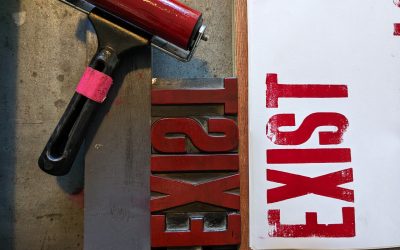
Hatch still functions as a fully working print shop, producing around 500-600 posters year, and when you find out that in general their minimum run of posters is 100 that’s a whole lot printing. I’ll be here for a week working alongside their printers and interns learning more about letterpress printing in a production environment.
There is a great video about Hatch here
And yes, they have cats, they are awesome. This one is called Huey, he has the build of a circus strong man

The Hamilton Type Museum
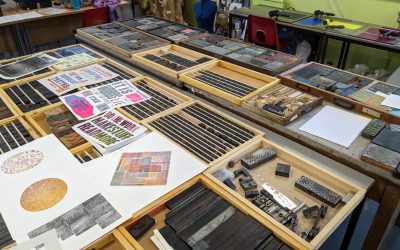
Type identification for letterpress can be a headache to say the least. When the trade was is it’s heyday the print shop was a bustling hive of organised chaos. Type was housed in labelled drawers, organised by it’s classification and it’s size. The furniture and leading for the type was also kept in strictly organised areas related to size (both by heigh and by width, for a specific height of type you need the same height of furniture). Individual letters were not labelled, the only way to find which case a rogue letter has come from would be to measure it and hopefully be able to recognise the design of type, thus allowing you survey the relevant cases of type and search for a telltale space amongst the rest of the type. All very well if you only have 1 cabinet with 4 cases of type for 4 totally different styles of type, not so enjoyable when you have a whole room filled with cabinets…which are filled with drawers…which are filled with 20-30 different styles of type…in about 10 different sizes. The print room was strictly controlled to prevent this happening, I found an old manual for print room bylaws and rules for unions and it had a whole section on people being fined for dropping type or if there was leftover type in their space.
Whilst working as functional print shops the type remained organised but as letterpress has slipped into obscurity the cabinets of type have been thrown away. The drawers have been emptied into boxes. The finely organised wooden furniture has been burnt. The lead spacers have been melted down for scrap or thrown away due to their awkward weight. If anything has been a saving grace for letterpress it is that (you would hope) even a lay person (I feel like a snob saying that but for once it is in it’s right context) would be able to look at a box of wooden type and see a basic beauty in their form, that and the fact that everything to do with the trade is so damned heavy and awkward to move. With the Type Museum gaining exposure, old printers (and in some cases old printers families) have been excited to find somewhere to donate their old presses and jumbled boxes of type to.
And so this is where you find me; sat amongst boxes and drawers, caked in dust in the huge back room of the Museum with a big smile on my face. One of my roles here has been to start sorting the donated type so that at one point it may be correctly organised, archived and integrated into the collection in the future.
Click “Read More” for the full story
The Hamilton Type Museum
As promised last week I thought it was time I did a post getting down to the nitty grtty stuff that Hamilton has been involved in during it’s functioning years. When Hamilton first went into the production of wood type he used a method that involved cutting the outline of a letter out of a very thin veneer of wood, this was then mounted on a block of wood to bring it up to type height. This method was soon replaced by the industry standard of routing a design directly into a block due to the time and inaccuracies involved in veneer cutting. However the preparation of the wood for routing was a long process…
Click read more for the full story
The Hamilton Type Museum – Day 2,3,4 – 28th,29th & 30th September
As I mentioned at the end of last week, my first project while at the Hamilton Wood Type and Printing Museum was to set a poster to be hung in the Print Room to remind students and workshops of the rules for printing in the space.
Letterpressing is a multifaceted process with many parts, along side the type used to create the prints (that is kept in chest high units of wide drawers around the outer walls of the Print Room) you also need furniture (varying sized wood blocks that are below printing height) to space out the type and leading (quite literally strips of lead in varying widths) that create space between each line of type. The Museum is blessed with an abundance of all of these important (and often overlooked) other components of the trade, coming from a printing background with little access to furniture or ever a type ruler (that can be used to measure type and furniture to allow you to match them up for a close fit) it has really been a learning experience setting such a large body of type.
The print took 3 days straight to design, set, proof, print and diss (meaning to disassemble and pack away the type and any furniture etc used). I’m very happy with it, not only will it be hung on the walls of the museum but it will also be sold along side all of there other amazing prints!
Below is a making of video for the print, I’d hoped to film a lot more however the strip lighting surrounding my print space was on the fritz, causing a filmic effect close to watching a man stare at little blocks of wood in a disco, so a judder stop frame animation it is then (Note to self : Buy a remote shutter release for camera)
There’s lots more photos, click Read More to see them!
The Schwartz House – 2nd October
So after a busy week letterpressing I was ready for some r’n‘r this weekend. What better way to relax than cycling 8 miles to see a beautiful remnant of 1930’s modernist architecture?

For more pictures and the full story, click Read More
Please wait while my tweets load